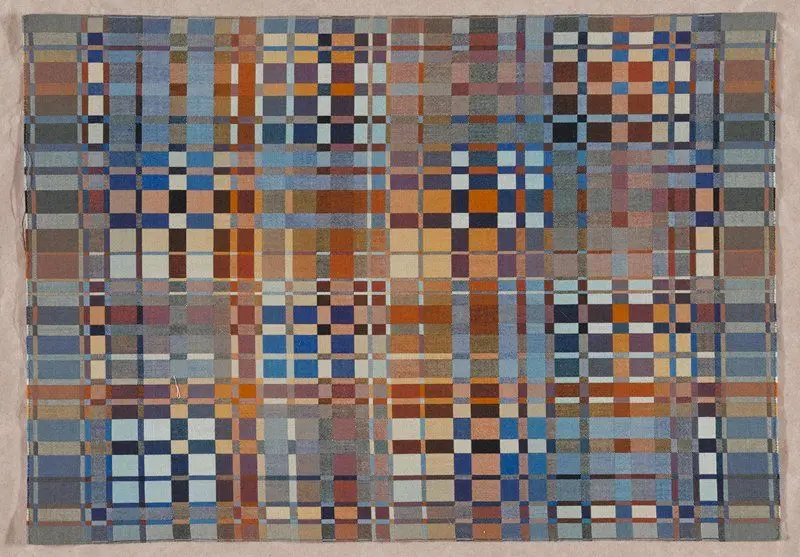
Weaving 1976
c. 1976
Double weave cotton
A woven textile features a complex geometric pattern of interlocking squares and rectangles in a variety of colors. The pattern is reminiscent of a plaid or checkerboard, with variations in size and spacing of the colored blocks. Richard Landis is best known for compact double-cloth textiles that explore color interaction. In double-cloth weaving, multiple sets of warp (vertical threads) and weft (horizontal threads) form two interlaced cloths, which, if they could be separated, would form complete textiles. With the weaver’s manipulation, the sets of warp and weft change sides, moving from the “front” to the “back” of the cloth. Landis exploits the movement of threads to experiment with color interplay: dark and light warp threads alternate back and forth to interlace with light and dark wefts, generating subtle, harmonious shifts in hue and tone. Gallery N
Tags
You may like
Building a new visual wall from this artwork...